---
title: Turn detection
description: "How a voice agent decides it is its turn to speak: the Turn detection card under Advanced, its Smart, Strict and None modes, and the turn timeout."
---
Voice agents
Turn detection decides when the caller has finished and the agent may answer. With
it off, the agent answers as soon as [voice activity detection](/build/speech-pipeline/voice-activity-detection)
hears enough silence. With it on, the agent also weighs what was said: a sentence
that trails off with "and my number is" is not a finished turn, however long the
pause.
:::tip[When to turn it on]
Callers who pause mid-sentence to find a card, read a reference or think. Turn it
on when transcripts show the agent answering half-questions. Leave it off for
short, fast exchanges such as yes-or-no verification.
:::
## How it works
The speech pipeline runs in this order for every caller turn:
1. [Noise reduction](/build/voice-and-audio/noise-suppression), if enabled, cleans
the audio.
2. [Voice activity detection](/build/speech-pipeline/voice-activity-detection)
finds the start and end of speech.
3. Turn detection decides whether that end of speech is the end of the turn.
4. The agent answers, or waits for more.
## Configuring it
1. Open the agent and choose **Advanced** under **Build**.
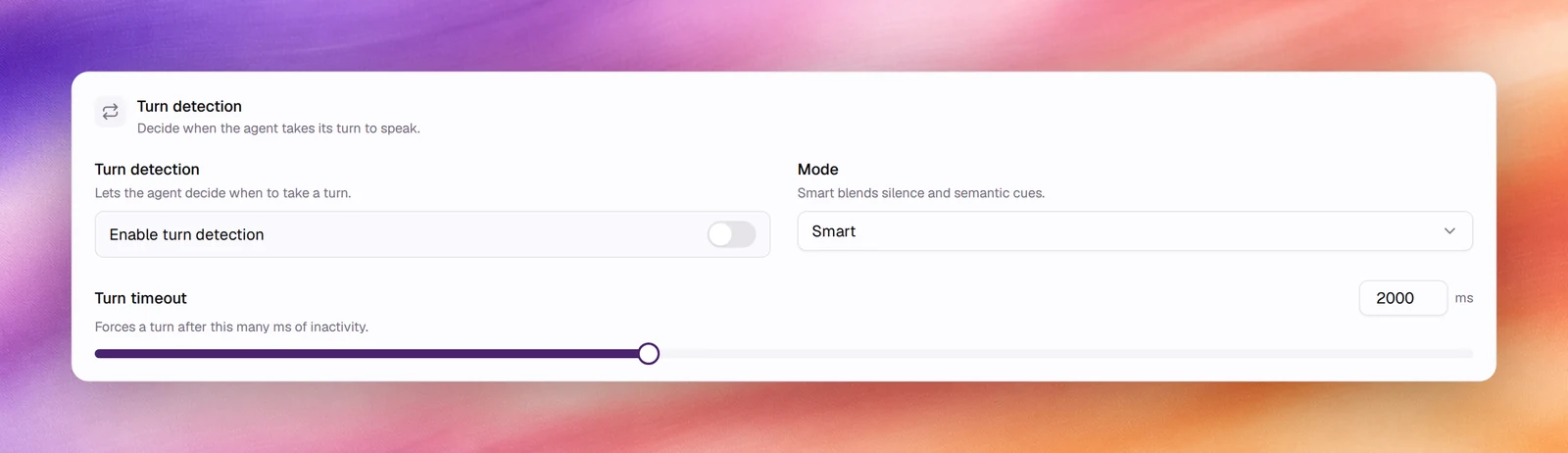
2. In **Turn detection**, switch on **Enable turn detection**.
3. Pick a **Mode** and set **Turn timeout**.
4. **Save**.
## Reference
| Field | Default | Unit or options | Range | What it does |
|---|---|---|---|---|
| **Enable turn detection** | Off | On, off | | Lets the agent decide when to take a turn |
| **Mode** | **Smart** | **Smart**, **Strict**, **None** | | **Smart** blends silence and semantic cues. **Strict** waits for a clear end of the turn before answering. **None** answers on silence alone |
| **Turn timeout** | 2000 | ms | 0 to 5000, step 100 | Forces a turn after this many ms of inactivity, whatever the mode decided |
## Choosing a mode
- **Smart** for most lines. It answers quickly on complete sentences and waits on
incomplete ones.
- **Strict** where being talked over is worse than a slow reply: legal notices,
medical intake, anything read back for confirmation.
- **None** where speed matters more than the occasional interruption, or to make the
card's other settings behave exactly like VAD alone.
**Turn timeout** is the safety net: if the caller stops without a clear end, the
agent takes its turn after this delay anyway. 2000 ms suits most calls; go lower for
snappy exchanges, higher when callers read long numbers aloud.
## Behaviour and limits
- Turn detection cannot make the agent answer faster than VAD's **Min Silence
Duration** plus **End-of-speech timeout** allow. Tune those first for latency.
- With the switch off, **Mode** and **Turn timeout** have no effect, though their
values are kept.
- The setting applies to the **Call** test as well as phone calls, so it can be
tuned from the browser.
## Verify
Start a call under **Testing**, **Call**, and say a sentence with a pause in the
middle: "my postcode is ... let me check ... SW1A 1AA". With **Smart** on, the agent
waits through the pause. Compare with the switch off.
## Troubleshooting
- **The agent interrupts callers.** Turn detection on, **Smart**, and raise VAD's
**Min Silence Duration**.
- **The agent takes too long to answer.** Lower **Turn timeout**, or switch to
**None** and tune VAD instead.
## Related
- [Voice activity detection](/build/speech-pipeline/voice-activity-detection)
- [Noise suppression](/build/voice-and-audio/noise-suppression)
- [Silence, reminders and call duration](/build/speech-pipeline/silence-reminders-and-call-duration)
- [Call quality metrics](/operate/call-quality-metrics)