---
title: Tools overview
description: "What a tool is, the 11 built-in tools, the capabilities text agents switch on, the fields every tool shares, and where tools are added."
---
A tool is an action the agent may take during a conversation: hang up, transfer,
hand the call to another agent, call an API, send an email, book a meeting, push
data to Zapier, look something up in a knowledge base, or reach an MCP server. The
prompt tells the agent what to do; tools are what it can actually do. An agent with
no transfer tool cannot transfer, whatever the prompt says.
:::tip[Add only what the agent should be allowed to do]
Every tool is a capability the model may decide to use. Give a receptionist **End
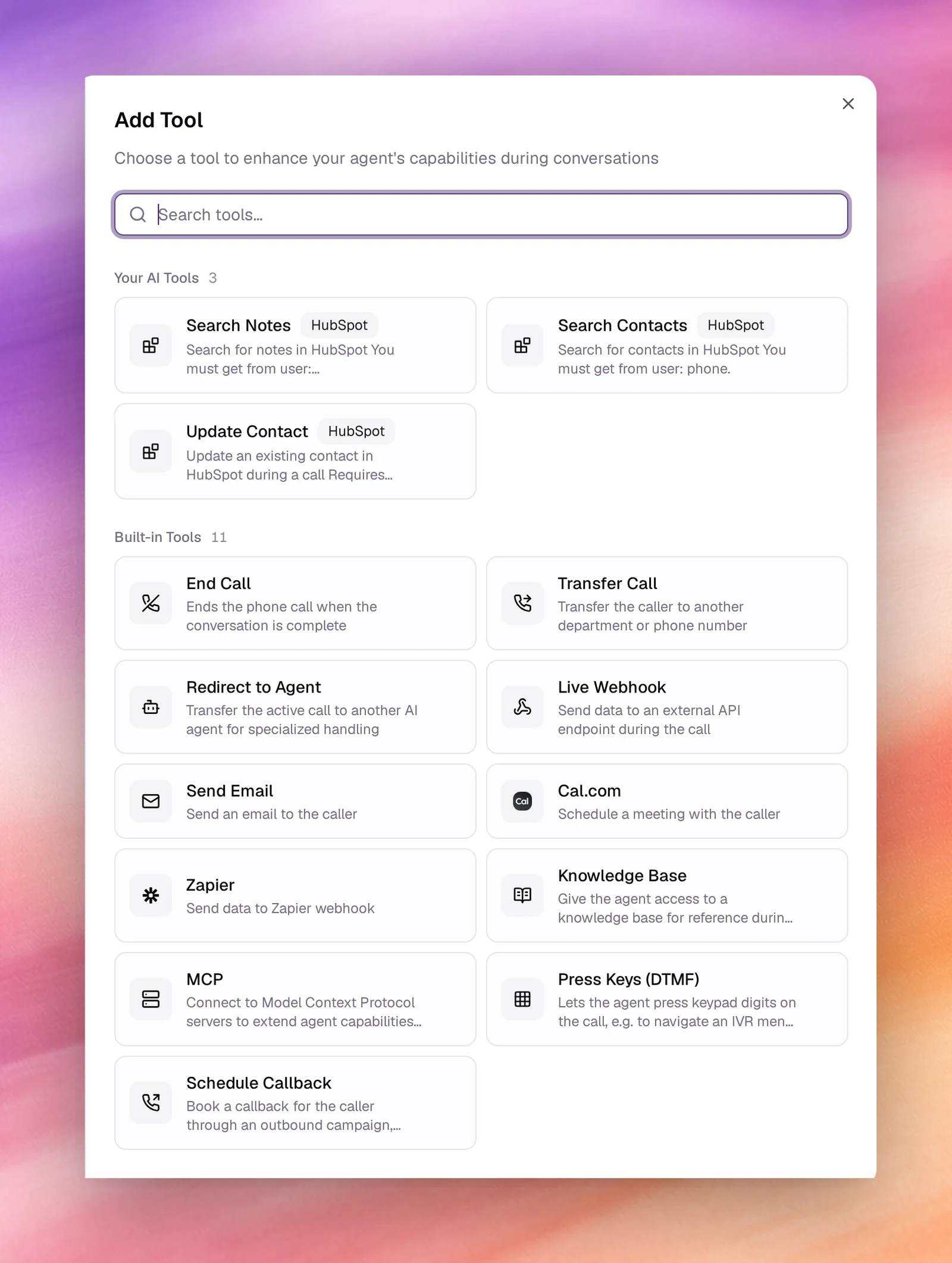
Call** and **Transfer Call**; give a lead-qualification agent **Send Email** and a
**Live Webhook** to the CRM. Leave out what the agent should never do.
:::
## The built-in tools
| Tool | What it does | Page |
|---|---|---|
| **End Call** | Ends the phone call when the conversation is complete | [End Call](/build/tools/end-call) |
| **Transfer Call** | Transfers the caller to another department or phone number | [Transfer Call](/build/tools/transfer-call) |
| **Redirect to Agent** | Hands the active call to another AI agent for specialized handling | [Redirect to Agent](/build/tools/redirect-agent) |
| **Press Keys (DTMF)** | Presses keypad digits on the call, for an IVR menu or a prompt | [Press Keys (DTMF)](/build/tools/press-keys) |
| **Schedule Callback** | Books a callback at a time the caller chooses, placed by an outbound campaign | [Schedule Callback](/build/tools/schedule-callback) |
| **Live Webhook** | Sends data to an external API endpoint during the call | [Live Webhook](/build/tools/live-webhook) |
| **Send Email** | Sends an email to the caller | [Send Email](/build/tools/send-email) |
| **Cal.com** | Schedules a meeting with the caller | [Cal.com](/build/tools/cal-com) |
| **Zapier** | Sends data to a Zapier webhook | [Zapier](/build/tools/zapier) |
| **Knowledge Base** | Gives the agent a knowledge base to consult during conversations | [Knowledge Base](/build/tools/knowledge-base) |
| **MCP** | Connects to a Model Context Protocol server for external tools and data | [MCP](/build/tools/mcp) |
The picker has a second section, **Your AI Tools**, for tools created from your
integrations. It reads **No AI tools available** until an integration provides
one. See [Integrations](/operate/integrations/overview).
A text agent's picker differs in two ways. The tools that act on a phone call
(**End Call**, **Transfer Call**, **Redirect to Agent**, **Press Keys (DTMF)** and
**Schedule Callback**)
are not offered. And an **Agent Capabilities** section lists abilities that are
switched on or off rather than configured:
| Capability | What it lets the agent do |
|---|---|
| **User Form** | Show a form to collect structured information: contact details, preferences, dates. |
| **Web Search** | Search the web for current information. |
| **Page Content** | Read the content of a web page, one the user shared or one found by search. |
| **Schedule Task** | Create reminders, recurring checks and other scheduled actions. Marked **Deployments only**: it works in messaging deployments such as Slack, Telegram, WhatsApp and Teams. |
| **Memory** | Store, search and delete facts about the user across conversations. Also **Deployments only**. |
A capability switched on is listed under **Configured tools** like any other tool.
## Where tools are added
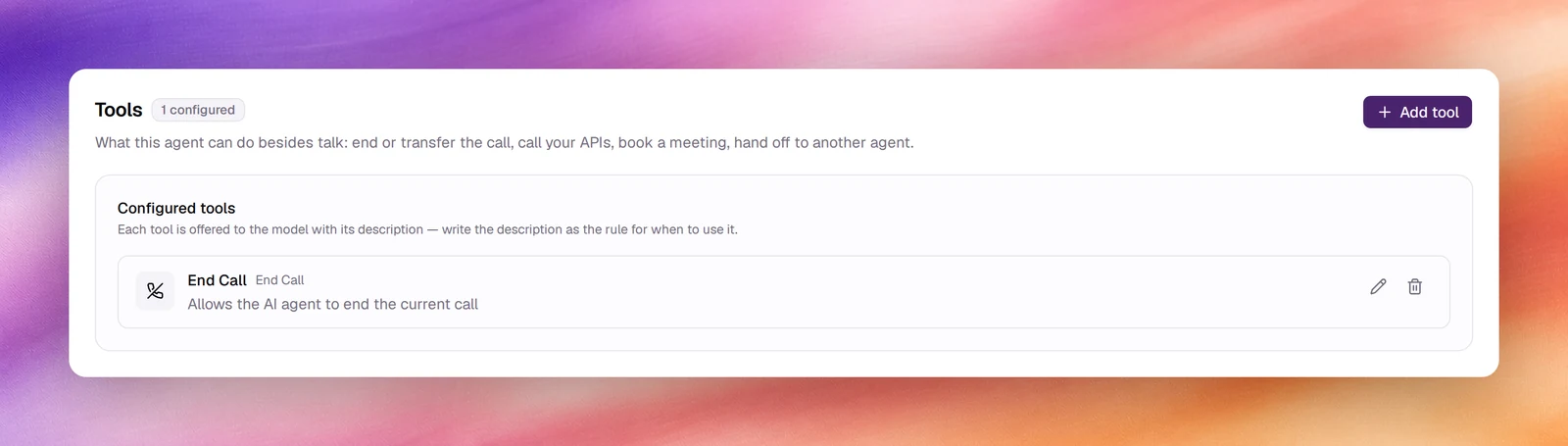
**Single-prompt agents.** Tools have their own section: **Tools** under **Build**. It
counts what is configured, lists each tool under **Configured tools** with its
description, and **Add tool** opens the picker. **Manage tools**, in the
**Prompt** card's header and its **Tools** bar, takes you to the same section; the
bar's own **Add tool** adds a tool and writes its usage line into the tasks (see
[Prompting guide](/build/prompting/prompting-guide#tasks)). Each tool is offered
to the model with its description, so write the description as the rule for when
to use it.
**Flow agents.** Tools live in two places in the [flow editor](/build/flow-agents/flow-editor).
**Global Tools**, in the toolbar's settings panel, are available at every node and
are managed the same way as the **Tools** section. Each **Prompt** node also has a **Tools**
tab for tools that apply at that node only, with an **Include Global Tools** switch
to add or withhold the global ones. The node picker does not offer **Knowledge
Base**; the node's **KB** tab does that job.
## Adding a tool
1. **Open the picker**
Open **Tools** under **Build**, or choose **Manage tools** in the **Prompt**
card, which goes there. Then choose **Add tool**. **Search tools…** narrows the
list.
2. **Pick a built-in tool**
Choose a card. The **Add New Tool** panel opens beside the page, headed by the
tool you picked, with the shared fields filled with defaults.
3. **Fill in the tool's own fields**
Each tool adds fields below **AI Response**; they are on the tool's page.
4. **Add Tool, then Save the agent**
**Add Tool** closes the form and lists the tool under **Configured tools**.
Choose **Save** at the top of the page; the tool is
part of the agent from that version on.
*Adding the Send Email tool to an agent, up to Add Tool.*
## Fields every tool shares
The top of every **Add New Tool** panel is the same: a card naming the tool you
picked, then three fields. The model reads **Description** to decide when to call
the tool and says **AI Response** while it does; **Tool Title** identifies it.
| Field | Type | Meaning |
|---|---|---|
| **Tool Title** | Text | The display name under **Configured tools**, for example `End Call`. The line under it shows the **ID** the model calls, made from the title: lower case, spaces as underscores, other characters dropped, so `End Call` becomes `end_call`. Keep titles unique within the agent. |
| **Description** | Text | What the tool does and when the agent should invoke it. This is the sentence the model reads, so put the trigger in it: `Transfer to the front desk when the caller asks for a person`. |
| **AI Response** | Text | What the agent says as it uses the tool, for example `Let me transfer you. Please hold on.` |
## Editing and removing
Under **Configured tools**, **Edit** reopens the panel as **Edit Tool** with
**Update Tool** in place of **Add Tool**; the tool itself cannot be changed, only
its fields. **Remove**
deletes the tool from the agent. Both take effect when you **Save** the agent, and
both are recorded as a new version.
## Behaviour and limits
- Tools are per agent. The same webhook on 2 agents is 2 tools.
- The agent decides when to call a tool from the **Description** and the
conversation. To make a call certain, use a flow agent and a node: a
[Webhook node](/build/flow-agents/nodes#webhook) fires whenever it is reached.
- Tool calls appear on the call's page under its transcript, with the request and
the response. See [Call details](/operate/call-details).
- Dynamic variables in double braces are substituted in webhook bodies, email
content and Zapier fields. See [Dynamic variables](/build/dynamic-variables).
## Related
- [Anatomy of an agent](/build/anatomy-of-an-agent)
- [Flow editor](/build/flow-agents/flow-editor)
- [Guardrails](/build/prompting/guardrails)
- [Integrations overview](/operate/integrations/overview)