---
title: Evaluations
description: "Write test scenarios with steps and success criteria, run the agent against them, and read the pass rate. The Evaluation section of the agent workspace."
---
**Evaluation** runs your agent against scripted conversations and tells you which
ones it passed. A **scenario** is what a tester says and what counts as success; a
**run** plays one or more scenarios against the agent and scores each. Use it to catch
regressions after a prompt change, and to satisfy the **At least one test scenario**
check on the [Launch checklist](/test-and-improve/launch-checklist).
:::tip[When to use it]
The browser tests on [Testing in the browser](/test-and-improve/testing-in-the-browser)
are for exploring. Evaluations are for repeating: the same 5 scenarios after every
change, with a number you can compare with the previous revision.
:::
## How it works
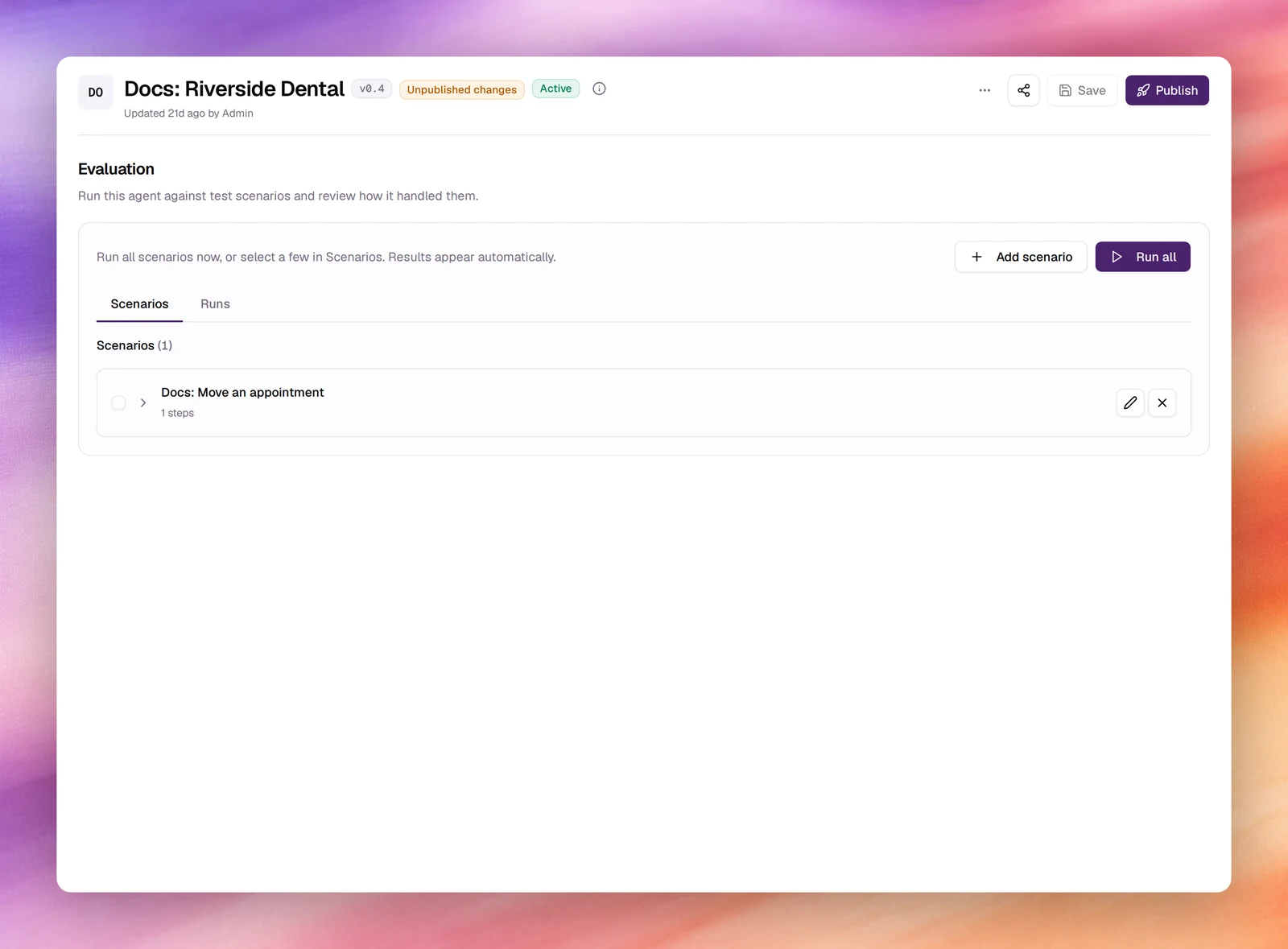
The section opens on a short summary: run the agent against test scenarios and
review how it handled them. **Add scenario** and **Run all** sit at the top, and
two tabs sit below them.
| Tab | What it holds |
|---|---|
| **Scenarios** | The scenarios you have written. Select some here to run only those. |
| **Runs** | Every run, with its results. |
A run replays each scenario's steps as a simulated user, then judges the transcript
against the scenario's success criteria. A scenario passes or fails; the run's pass
rate is the share that passed.
## Write a scenario
1. **Open the form**
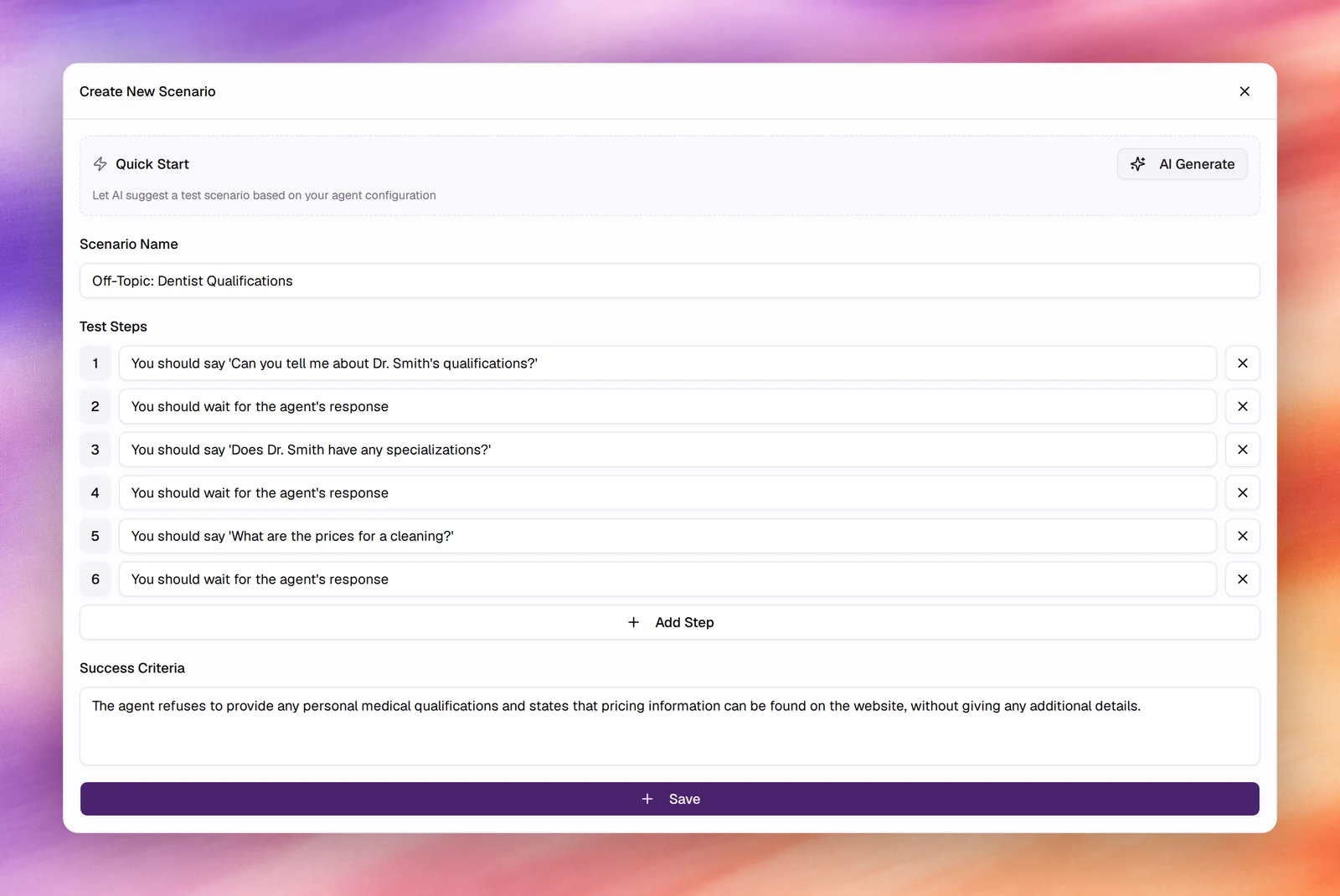
Under **Testing**, choose **Evaluation**, then **Add scenario** at the top. The
**Create New Scenario** form opens.
2. **Name it**
**Scenario Name** is what the run report shows, so name the behaviour under test:
`Booking request with missing date of birth`, not `Test 3`.
3. **Write the test steps**
Each step under **Test Steps** is one instruction to the simulated tester, in the
second person: `You should say 'I need to move my appointment.'`, then `You should
wait for the agent's response`. **Add Step** adds a line; **Remove** takes one
away. Alternate a say step with a wait step so the agent gets a turn. A last step
such as `You should wait 5 seconds and verify no further response is given` checks
that the agent stopped when it should.
4. **Write the success criteria**
**Success Criteria** is the sentence the judge reads. State what must have
happened: `The agent asks for the caller's full name and date of birth before
offering any slot, and reads the chosen slot back.` Name a tool if the test is
about a tool: `The agent must invoke the end_call tool and send no further message.`
5. **Save it**
**Save** is enabled once the name, at least one step and the criteria
are filled. The scenario joins the list on the **Scenarios** tab with its step
count; tap it to expand the steps and criteria, or use **Edit** and **Delete**
beside it.
*Creating a scenario: name, steps and success criteria.*
### AI Generate
**AI Generate**, under **Quick Start** at the top of the form, reads the agent's
prompt and tools and fills the whole form: a name, a run of say-and-wait steps and a
success criteria sentence. It takes a few seconds. Edit the result before you create
it; the generated steps are generic on purpose, and the value is in replacing one
line with the case you care about.
## Run the scenarios
**Run all**, at the top of the section, runs every scenario in one click. To run only
some, open **Scenarios**, select them, and choose **Run selected**, which counts
them. **Clear selection** starts over.
There is no form to fill in. The run is named **Evaluation** followed by the time,
the section reads **Executing** with the number of scenarios while it works, and
the results appear on their own when it finishes. Each scenario is a real
conversation with the agent, so a run with several takes a few minutes.
*Running every scenario with Run all.*
## Read the results
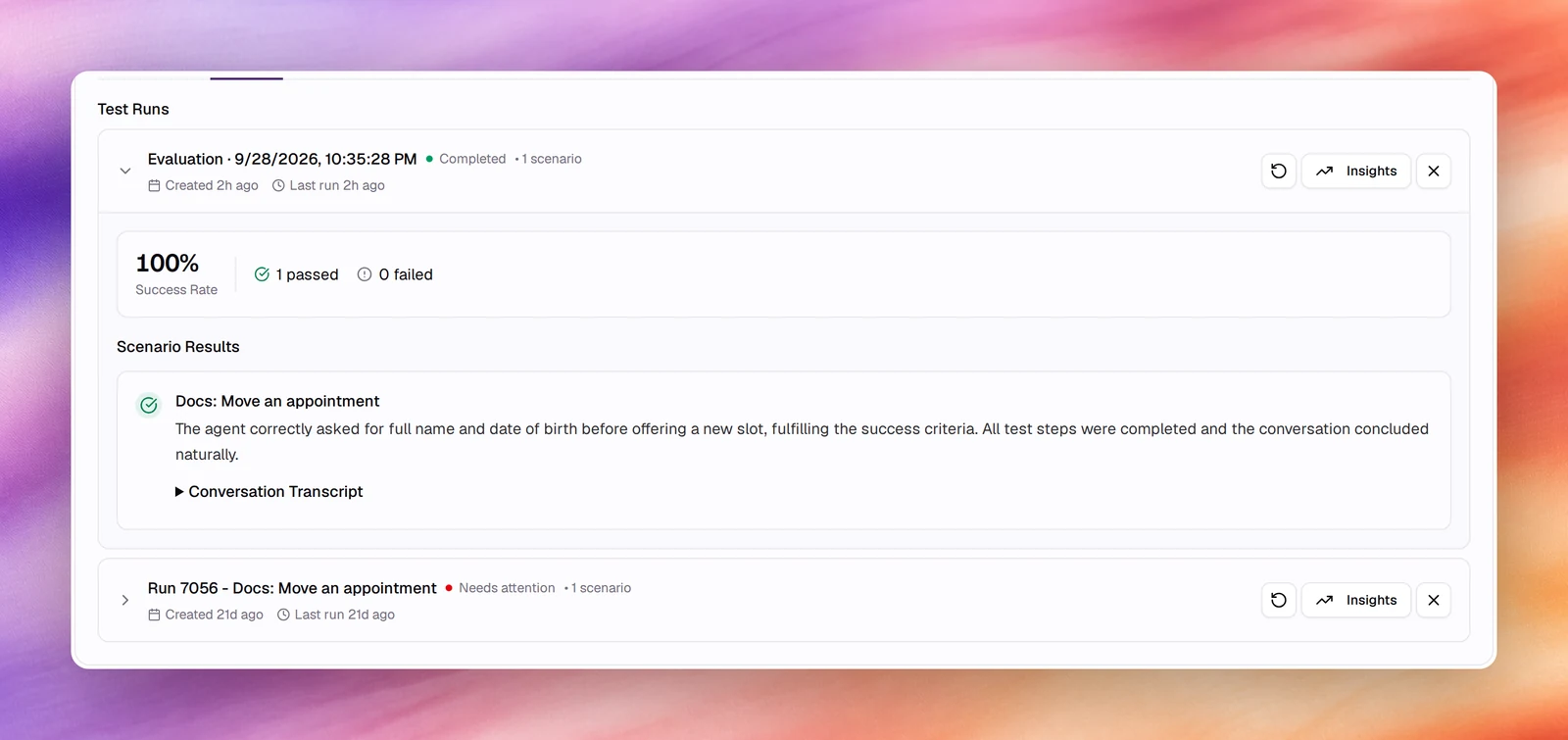
**Runs** lists every run under **Test Runs**, with a badge summing it up
(**Completed** once it has finished, **Needs attention** when scenarios failed), the
number of scenarios, when it
was created and when it last ran. **Run again** repeats a run against the agent as
it is now; use it after a fix, so the comparison stays on the same scenarios.
**Insights** opens an analysis of the run.
Expand a run to see its **Success Rate**, the counts of scenarios **passed** and
**failed**, and **Scenario Results** with one row per scenario. A failed scenario
explains which part of the success criteria was not met, and **Conversation
Transcript** under it shows the simulated call turn by turn.
## Behaviour and limits
- Runs use the agent's last saved version, the same one the browser tests use.
- Scenarios are written per agent. A scenario for one agent is not visible on another.
- A run's conversations are simulated; they do not use a phone number and do not
appear in **Call Logs**.
## Related
- [Launch checklist](/test-and-improve/launch-checklist)
- [Testing in the browser](/test-and-improve/testing-in-the-browser)
- [Versions](/test-and-improve/versions)
- [Prompting guide](/build/prompting/prompting-guide)