

Voice activity detection
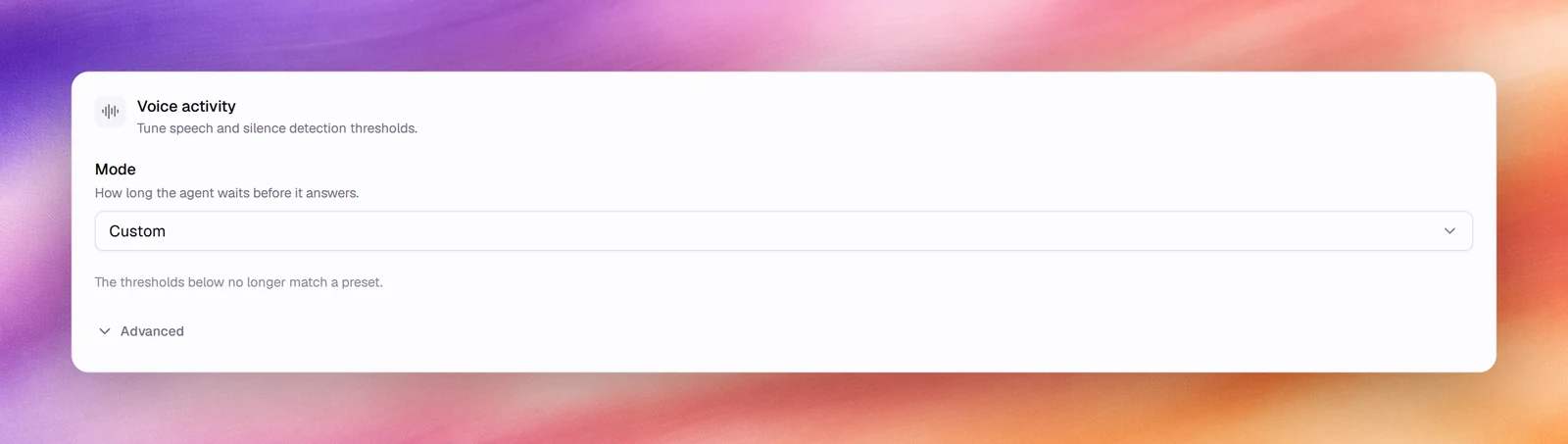
The Voice activity card under Advanced: a Mode preset for how long the agent waits before it answers, and the five thresholds behind it.
Voice agentsVoice activity detection (VAD) listens to the caller’s audio and marks where speech starts and stops. Every downstream step, transcription, turn detectionTurn detectionHow the agent decides the caller has finished speaking and it is its turn.See the glossary and the silence timers, works from those marks. The Voice activity card under Advanced sets them with a Mode, how long the agent waits before it answers, and exposes the five thresholds behind it under Advanced.
Configuring it
- Open the agent and choose Advanced under Build.
- In Voice activity, pick a Mode. To tune one threshold instead, open Advanced in the card and drag its slider or type into its field.
- Save.
Modes
A mode is a preset for all five thresholds. Nothing stores the mode itself: the card reads it back from the values, so changing any threshold by hand shows the mode as Custom (The thresholds below no longer match a preset.). An agent that was never tuned reads as Balanced.
| Mode | For | Min speech | Min silence | Activation | Prefix padding | End-of-speech |
|---|---|---|---|---|---|---|
| Fast | Short, brisk exchanges: replies as soon as the caller pauses | 100 ms | 100 ms | 0.4 | 100 ms | 0 ms |
| Balanced | The recommended trade-off between responsiveness and interrupting | 100 ms | 200 ms | 0.5 | 200 ms | 100 ms |
| Patient | Callers who think mid-sentence: waits longer before replying | 200 ms | 600 ms | 0.6 | 300 ms | 500 ms |
Reference
| Field | Default | Unit | Range | What it does |
|---|---|---|---|---|
| Min speech duration | 100 | ms | 100 to 3000, step 100 | Shortest sound considered speech. Lower = more eager |
| Min Silence Duration | 200 | ms | 100 to 3000, step 100 | Silence required to treat the user as done speaking |
| Activation threshold | 0.5 | 0.1 to 0.9, step 0.1 | How loud or speech-like audio must be to count as speech. Lower = more sensitive, more false positives | |
| Prefix Padding Duration | 200 | ms | 100 to 3000, step 100 | Audio prepended to detected speech, so the first syllable is not cut |
| End-of-speech timeout | 100 | ms | 0 to 3000, step 100 | Silence required before treating the turn as ended |
What each one changes
- Min speech duration filters clicks and coughs. Raise it if the agent reacts to noise; lower it if it misses “yes” and “no”.
- Min Silence Duration is the pause that ends a caller’s speech. Raise it for callers who pause between phrases; lower it for faster replies.
- Activation threshold is the sensitivity. Raise it on noisy lines, or turn on noise reduction first and leave it alone.
- Prefix Padding Duration keeps the start of words. Rarely needs changing; raise it if transcripts lose first syllables.
- End-of-speech timeout is added after the silence before the turn is handed on. Together with Min Silence Duration it sets the floor of the agent’s response time.
Behaviour and limits
- Response latency is at least Min Silence Duration plus End-of-speech timeout, plus the model’s own time. With the defaults these two add 300 ms.
- Turn detection can delay a turn beyond what VAD decided but never shorten it.
- The Max silence timer under Reminders counts time in which VAD heard no speech; a threshold set too high can make a talking caller look silent.
- The settings apply to the browser Call test too.
Verify
Start a call under Testing, Call, say short words and long sentences, and watch the transcript: every utterance should appear once, complete, and the agent should answer after a natural pause.
Troubleshooting
- The agent answers before I finish. Switch the Mode to Patient, or raise Min Silence Duration in 200 ms steps; then turn on turn detection.
- The agent is slow to answer. Switch the Mode to Fast, or lower End-of-speech timeout first, then Min Silence Duration.
- Background noise triggers the agent. Enable denoising, then raise Activation threshold by 0.1.